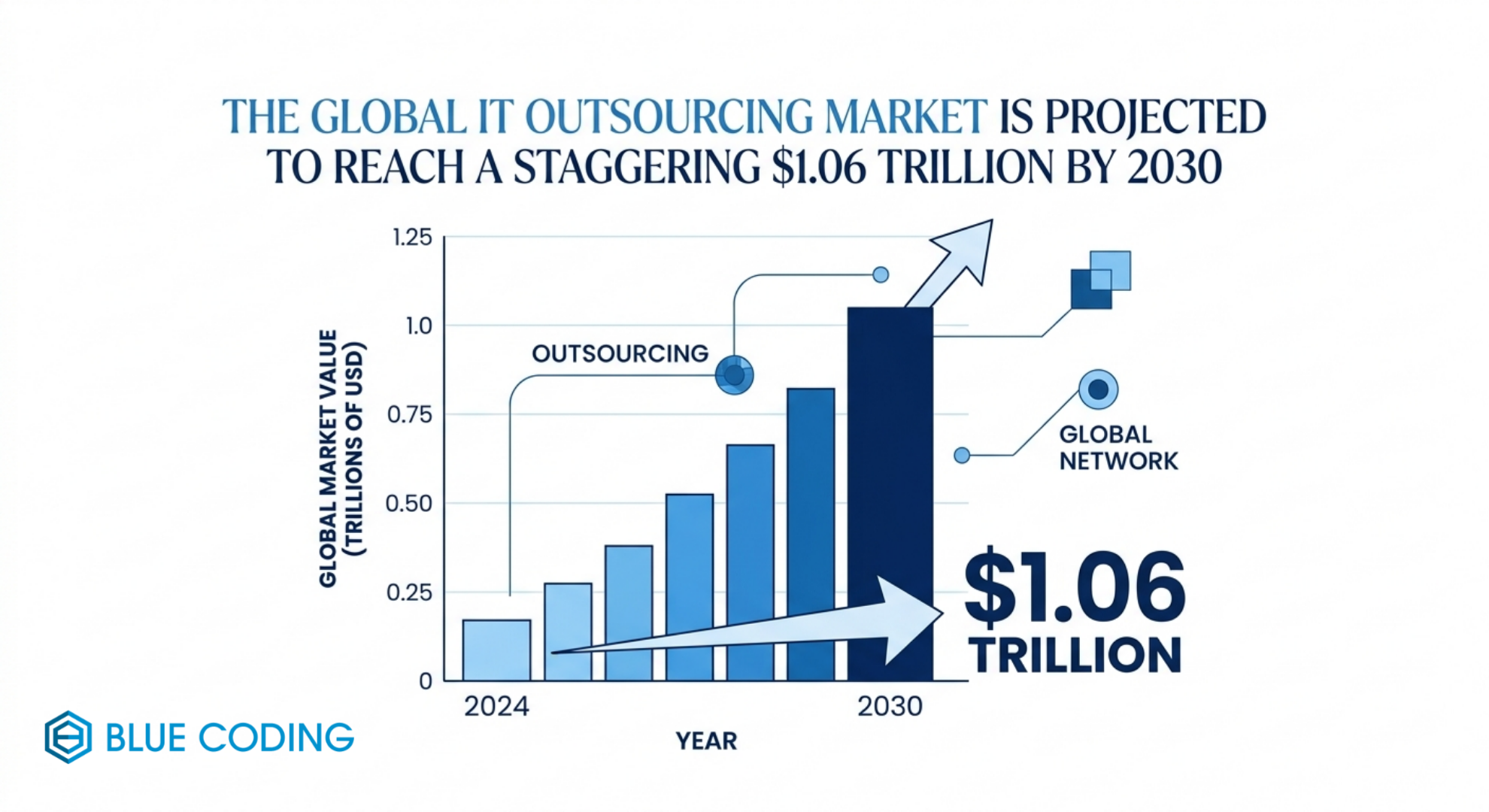
With the IT outsourcing market projected to hit $1.06 trillion by 2030, is your company ready? Learn how scalable software teams provide the elasticity needed to dominate the market.


.svg)
.svg)
The business landscape today focuses more on who has the most agile engine. As we look toward 2030, the global IT outsourcing market is projected to reach a staggering $1.06 trillion, reflecting a fundamental shift in how successful companies operate. We are moving away from the era of hiring for seats and entering the era of hiring for impact. For growing companies, the traditional model of building every single department in-house is becoming a bottleneck. To maintain a competitive edge, leadership teams are now adopting a technology staff augmentation strategy that treats external talent not as a vendor, but as a high-performance extension of their core mission.
For years, the word outsourcing was synonymous with cheap. Today, that narrative has flipped. According to recent industry data, only 34% of organizations now cite cost reduction as their primary reason for seeking outside help. Instead, the focus has shifted toward value creation and access to specialized talent. The new business services model is built on the realization that your internal team should focus on your secret sauce, which is the core product vision and customer relationships. Meanwhile, external software development teams handle the heavy lifting of technical execution, cloud-native migrations, and security hardening. This allows your business to stay lean while operating with the power of a global enterprise. When you look at the most successful startups that have scaled into unicorns over the last decade, a common thread emerges: they did not wait to find the perfect local hire for every single role. They leveraged global networks to find specialized skills that were unavailable in their immediate geography. This allowed them to iterate faster, fail cheaper, and succeed sooner.
One of the biggest risks for a growing company is hiring lag. By the time you find, interview, and onboard a senior developer, the market opportunity might have already shifted. This is where scalable software teams become a strategic lever.
Growth is rarely linear. It comes in waves. A company might land a massive contract that requires a complete overhaul of its user interface within three months. Attempting to hire a full-time UI/UX team in that timeframe is a recipe for stress and potential failure. However, by tapping into a pool of scalable software teams, that same company can onboard three world-class designers in forty-eight hours. This level of responsiveness is what defines the winners in the modern economy.
Many CTOs worry that bringing in outside help will lead to a messy codebase. However, a modern technology staff augmentation strategy is designed to integrate seamlessly into your existing workflows. Whether you use Jira, Slack, or GitHub, augmented developers function exactly like your full-time employees. They attend your stand-ups, follow your documentation standards, and report to your managers.
The real benefit lies in filling niche gaps. In today’s market, finding a developer who is an expert in both legacy system modernization and new AI protocols is nearly impossible. Staff augmentation allows you to plug in that specific expertise exactly when you need it, without the long-term commitment of a permanent salary. This model also reduces the burden on your HR department. Managing payroll, benefits, and local labor laws for a diverse technical team is a massive administrative undertaking. When you use a staff augmentation model, the partner agency handles the administrative complexities, leaving you to focus solely on the output and the technical direction.
We are currently seeing a massive shift in how users find information. With the rise of answer engines, your website’s authority is no longer just about keywords; it’s about being cited as a reliable source of truth. Leveraging external software development teams gives you the bandwidth to build the technical infrastructure, such as high-performance APIs and structured data schemas, that AI agents need to read and recommend your brand. If your internal team is bogged down by routine maintenance, you will lose the race to AI visibility. By using external partners for routine sprints, your core team can focus on the high-level strategy required to win in this new digital ecosystem.
The technical requirements for AI visibility are rigorous. It requires a level of schema markup and data cleanliness that most legacy websites simply do not possess. An external team can perform a comprehensive technical audit and implement these changes across thousands of pages while your internal developers continue to build out the features your customers are asking for. This parallel processing is the only way to keep up with the speed of AI evolution.
The data is clear: 92% of the world’s largest companies already use IT outsourcing to maintain their lead. For mid-market companies, IT outsourcing for growth is the only way to compete with these giants. It levels the playing field.
By partnering with a nearshore or specialized firm, you gain:
The financial implications of this model are also significant. Internal hiring involves hidden costs including office space, hardware, software licenses, and training. When you factor in the average cost of a bad hire, which can be up to fifteen times the employee's salary, the risk of traditional hiring becomes apparent. IT outsourcing for growth mitigates this risk by providing a flexible framework where you only pay for the value delivered.
The most successful software teams are hybrid, not just in terms of location, but in terms of tools. The best external partners are already using AI-assisted workflows to accelerate coding and testing. When you hire an external team today, you aren't just hiring people; you are hiring their advanced tech stack and their ability to ship code faster and with fewer bugs than a traditional manual team. This shift toward AI-enabled development means that the definition of a developer is changing. It is no longer just about someone who can write syntax, but someone who can orchestrate AI tools to produce high-quality results at scale. External teams are often at the forefront of this transition because their survival depends on their efficiency. By bringing them into your organization, you are effectively importing these advanced workflows into your company culture.
In the past, your talent pool was limited by the commuting distance to your office. This created a bidding war for talent in tech hubs like San Francisco, New York, or London. The new business services model breaks these walls. You can now access the top 1% of developers in Latin America, Eastern Europe, or Southeast Asia.
These developers are often more motivated and bring a different cultural perspective that can be invaluable for global products. For example, a developer in a high-growth emerging market might have a better understanding of how to build light, mobile-first applications for users with inconsistent internet connections. This kind of localized knowledge can be the difference between a product that flops and one that thrives in new markets.
One of the most frequent questions we hear is about security. How do you protect your intellectual property when working with external software development teams? The answer lies in the maturity of modern security protocols. From SOC2 compliance to encrypted virtual desktops, the tools available today make working with an external team just as secure as working with someone in the next cubicle. Culturally, the key to success is integration. The companies that see the best results are those that treat their external partners as true teammates. This means including them in company updates, giving them access to the same tools, and celebrating wins together. When the line between internal and external blurs, you achieve a level of synergy that drives true exponential growth.
Blue Coding architects the momentum your business needs to stay ahead. By connecting you with elite nearshore talent, we bridge the gap between your current capacity and your most ambitious growth targets. We understand that sustainable scaling requires more than just filling seats; it requires dedicated partners who treat your codebase with the same precision and care as your internal team. Whether you need to inject specialized expertise into an existing project or build a groundbreaking new product from the ground up, we handle the technical heavy lifting so you can focus on high-level strategy. If you are ready to remove the friction from your development cycle but aren't sure where the first brick goes, we are here to help. We offer a first free call to dive into your technical challenges and help you map out a clear, actionable roadmap for your next phase of growth. Contact us today to book your session and start building.


Subscribe to our blog and get the latest articles, insights, and industry updates delivered straight to your inbox